
Is Trucking a Good Career for Young Canadians in BC?
26 July 2026
Choosing a career is a major decision, especially for young Canadians who want stable work, good earning potential, and opportunities to grow without necessarily spending four years at university.
For many people in British Columbia, trucking can be a practical career option. The province depends on commercial drivers to move food, construction materials, retail products, industrial equipment, and other essential goods between communities and across provincial and international routes.
So, is trucking a good career for young Canadians in BC?
Yes. Commercial driving is a practical career path for young Canadians because Canada depends on trained drivers to move goods, people, equipment, and supplies. In BC, Class 1, Class 2, Class 3, and Class 4 licences can lead to trucking, bus driving, delivery, construction, passenger transportation, and logistics careers. Banur Driving School in Surrey helps students prepare with professional training, safety-focused instruction, and road test preparation.
This guide explores the career outlook, earnings, qualifications, lifestyle, opportunities, and important considerations for young people interested in becoming truck drivers in British Columbia.
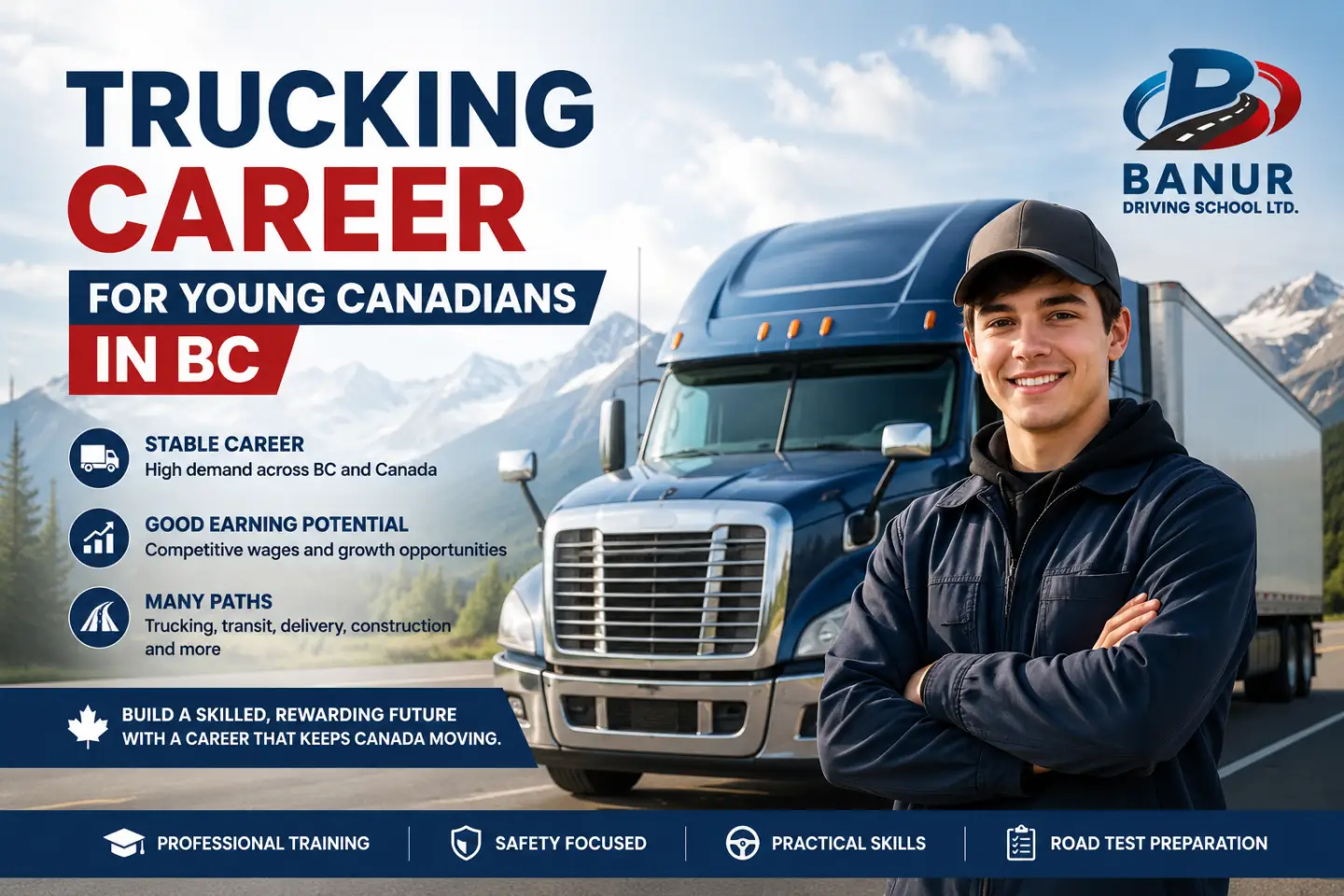
Why is trucking important in British Columbia?
British Columbia has a large and diverse geography. Goods need to move between major urban centres, ports, warehouses, construction sites, resource communities, retail businesses, and smaller communities across the province.
Truck drivers support many sectors of the economy, including:
- Transportation and warehousing
- Construction
- Mining
- Oil and gas
- Wholesale trade
- Retail
- Manufacturing
- Food and grocery distribution
- Forestry and related industries
Truck driving is also much broader than long-haul transportation. Depending on the licence, training, experience, and employer requirements, drivers may work in local delivery, regional transport, construction, specialized hauling, dump truck operations, towing, or other commercial driving roles.
This variety gives young drivers the opportunity to explore different career paths as they gain experience.
Driving careers in BC: Class 1, Class 2, Class 3 and Class 4
Transportation is the backbone of Canada's economy. Every grocery store, construction site, warehouse, school, farm, hospital, and business depends on trained professional drivers to keep people and products moving.
For young Canadians looking for a practical career, commercial driving can be a strong option because it offers hands-on work, steady demand, and multiple career paths without spending years in college or university. With the right licence and training, students can move into trucking, transit, delivery, construction, passenger transportation, or specialized commercial driving.
Class 1 career path
A Class 1 licence opens the door to tractor-trailer, long-haul, highway, local, regional, container, fuel, flatbed, construction, and logistics driving jobs. In British Columbia, transport truck drivers have a reported wage range of about $22.00 to $40.38 per hour, with a provincial median around $30.77 per hour. Earnings can increase with experience, a good driving record, specialized work, overtime, long-haul routes, or owner-operator opportunities.
Class 2 career path
A Class 2 licence is commonly used for bus driving and passenger transportation careers, including transit, shuttle, school bus, tour bus, and community transportation roles. WorkBC projects thousands of future openings for bus drivers and transit operators in BC, making this a practical career path for people who enjoy driving and working with the public.
Class 3 career path
A Class 3 licence can lead to jobs operating dump trucks, straight trucks, concrete trucks, recycling trucks, delivery trucks, construction vehicles, and municipal service vehicles. This is a strong option for students who want commercial driving work but may not want long-haul tractor-trailer driving.
Class 4 career path
A Class 4 licence can support careers in shuttle driving, ride-hailing, taxi, limousine, community transport, medical transport, and small passenger vehicle services. In BC, taxi and limousine drivers and chauffeurs show a median wage around $20.77 per hour, with higher wages possible depending on the employer, location, schedule, and type of work.
Why can trucking be a good career for young Canadians?
There are several reasons why young Canadians may consider trucking or another commercial driving career.
A direct path into a skilled career
One advantage of professional driving is the opportunity to develop job-focused skills without necessarily completing a traditional four-year university degree.
However, professional driving requires much more than simply knowing how to drive. Commercial drivers need proper licensing, road knowledge, vehicle control skills, safety awareness, inspection knowledge, and responsible decision-making.
For young adults who enjoy practical learning, commercial driver training can provide a focused pathway towards developing career-related skills.
Competitive earning potential
Income is an important factor when choosing any career. As mentioned above, transport truck drivers in BC can expect hourly pay in the low $20s to low $40s.
These figures do not mean that every new driver will immediately earn the median or highest wage. Actual income depends on factors such as experience, employer, location, route, working hours, specialization, and type of commercial driving work.
As drivers gain experience and develop a reliable safety record, they may become eligible for different driving roles or specialized opportunities.
Future job opportunities
WorkBC forecasts approximately 15,350 job openings for transport truck drivers in British Columbia between 2025 and 2035.
Job opportunities can result from industry demand, employee turnover, and the retirement of existing workers. However, employment conditions can differ between regions, employers, and specialized driving roles.
For young drivers, flexibility and a willingness to gain experience can be valuable when entering the industry.
Different career and growth options
Many people think trucking only means driving long distances and spending weeks away from home. In reality, commercial driving includes different types of work.
Drivers may explore local, regional, or long-haul transportation as well as construction, delivery, flatbed, dump truck, specialized equipment, and other driving opportunities.
With experience and additional training, some drivers may also progress into roles such as driver training, dispatch, fleet supervision, safety, transportation coordination, operations, or management.
This means commercial driving can be the starting point for a longer career in the transportation and logistics industry.
What skills do young truck drivers need?
Truck driving requires technical ability and responsible decision-making. Young drivers need to develop skills that help them operate vehicles safely and work professionally.
Important skills include:
- Safety awareness: Understanding following distances, braking, turning, blind spots, road conditions, and defensive driving.
- Vehicle inspection skills: Knowing how to perform required inspections and identify possible safety concerns.
- Time management: Managing routes, delivery schedules, traffic conditions, rest requirements, and appointments.
- Focus and patience: Staying alert and making calm decisions during heavy traffic, difficult weather, and long driving periods.
- Communication: Communicating clearly with dispatchers, customers, passengers, warehouse staff, and other professionals.
- Responsibility: Taking care of the vehicle, cargo, passengers, documentation, and applicable driving responsibilities.
Professional training can help students develop these skills in a structured environment before working independently.
How do you start a truck driving career in BC?
The first step is deciding what type of commercial driving work you want to pursue. This helps determine the licence class and training pathway you need.
A general career path may include:
- Research the commercial licence class required for your preferred job.
- Confirm that you meet the applicable licensing and medical requirements.
- Study the relevant commercial driving knowledge.
- Complete required or appropriate professional driver training.
- Develop practical skills in vehicle control, inspections, backing, turning, and safe road operation.
- Pass the required knowledge and road testing.
- Begin applying for suitable entry-level driving opportunities.
- Continue developing your safety record and professional skills.
For Class 1 licensing, drivers should review current BC requirements carefully, including applicable training standards and air brake requirements.
Choosing proper training is important because employers are looking for more than a licence. They need drivers who can operate commercial vehicles safely, inspect equipment correctly, make responsible decisions, and adapt to real road conditions.
Why young Canadians should consider trucking and commercial driving
Commercial driving is not just a job, it is an essential career. Canada needs trained drivers to support supply chains, construction, public transportation, delivery services, and local businesses. For students who want to start earning sooner, avoid heavy student debt, and build a real-world skill, Class 1, Class 2, Class 3, and Class 4 training can open the door to stable employment and long-term career growth.
Banur Driving School helps students in Surrey and the Lower Mainland prepare for commercial driving careers through professional training, road test preparation, safety-focused instruction, and practical coaching for real-world driving.
Is trucking worth it for young Canadians in BC?
For the right person, yes. Trucking offers young Canadians a practical route into the transportation industry, competitive earning potential, different types of driving work, and opportunities for long-term career development. As the job outlook numbers above show, demand for qualified drivers is not slowing down, which means the occupation should continue to offer real opportunities across British Columbia for years to come.
That said, trucking should not be viewed as an "easy job." Professional drivers need skill, patience, responsibility, safety awareness, and the ability to work under changing conditions.
Young Canadians considering this career should learn about the different licence classes, compare local and long-haul lifestyles, understand training requirements, and choose a professional training path that prepares them for real-world driving.
Start your truck driving journey with Banur Driving School
If you are considering a career as a professional truck driver in British Columbia, proper training is an important first step.
Banur Driving School provides truck driver training in Surrey, BC, with a focus on practical skills, safe driving habits, vehicle control, inspections, and road test preparation.
Whether you are exploring commercial driving as your first career or looking for a new professional direction, structured training can help you understand the responsibilities of commercial driving and prepare for the next stage of your journey.
Ready to explore truck driver training in Surrey, BC? Contact Banur Driving School to learn more about available training options and take the first step towards a professional driving career.
Frequently asked questions
Is truck driving in demand in British Columbia?
WorkBC forecasts 15,350 job openings for transport truck drivers in BC between 2025 and 2035. Opportunities vary by region, experience level, specialization, and employer requirements.
How much do truck drivers earn in BC?
According to WorkBC, transport truck drivers in British Columbia have average annual earnings of $68,079. The provincial hourly wage ranges from $22.00 per hour at the low end to $40.38 per hour at the high end, with a median wage of $30.77 per hour. Actual earnings can vary based on experience, employer, route type, schedule, location, and specialized driving work.
Is trucking a good first career?
It can be. Trucking may suit young adults who prefer practical work, enjoy driving, can work independently, and are prepared to take responsibility for safety and equipment.
Do I need a university degree to become a truck driver in BC?
A university degree is not generally required to become a transport truck driver. However, proper commercial licensing, training, testing, and other applicable requirements are necessary depending on the vehicle and type of work.
What licence do I need to drive a truck in BC?
The required licence depends on the vehicle. A Class 1 licence is required for heavy-duty combination vehicles, while a Class 3 licence covers certain commercial vehicles with more than two axles. Air brake requirements also apply to vehicles equipped with air brakes.
Is truck driving difficult for beginners?
Learning commercial driving can be challenging because learners need to develop vehicle control, inspection skills, backing techniques, road awareness, and safe decision-making. Structured training and regular practice can help beginners develop these skills progressively.