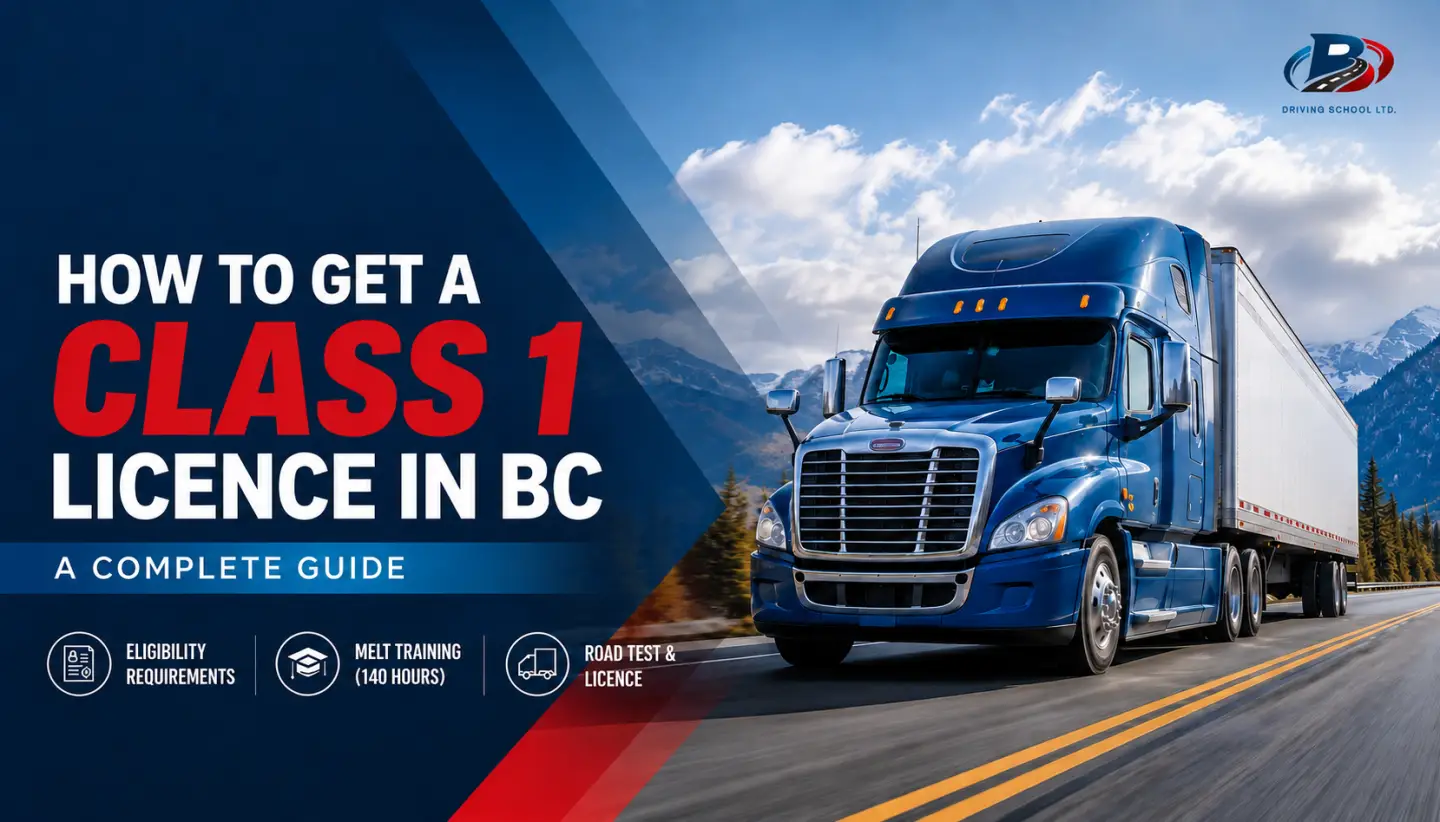
How to Get a Class 1 Licence in BC: A Complete Guide
21 August 2026
A Class 1 licence is the highest level of commercial driver's licence in British Columbia. It qualifies you to operate tractor-trailers and other heavy combination vehicles, opening the door to long-haul, cross-border, and specialized trucking careers.
Getting a Class 1 licence in BC means completing a mandatory 140-hour MELT program, passing an ICBC knowledge test, and finishing with a road test. The total timeline depends on your training schedule, availability, and road test timing. This guide covers eligibility, training, costs, and what to expect at each stage.
What Is a Class 1 Licence in BC?
In BC, a Class 1 driver's licence allows qualified drivers to operate tractor-trailers and other heavy vehicle combinations used in commercial transportation.
A Class 1 licence can open opportunities in areas such as:
- Long-haul trucking
- Local and regional freight transportation
- Construction transportation
- Logistics and distribution
- Heavy commercial transportation
- Trucking and fleet operations
The minimum age to obtain a Class 1 licence in BC is 19 years old.
How to Get a Class 1 Licence in BC: Step by Step
Step 1: Meet the Eligibility Requirements
Before you can enrol in Class 1 training, ICBC requires you to meet a few baseline conditions:
- Age: You must be at least 19 years old.
- Existing licence: You need a valid, full-privilege Class 5 or Class 6 licence, meaning you're past your learner and novice stages.
- Clean driving record: You must meet ICBC's commercial driver record pre-screening requirements.
If you're unsure whether your current licence or driving history qualifies you, confirm with your driving school before you commit to a training schedule.
Step 2: Complete Your Medical Exam
Commercial driving comes with a higher physical standard than driving a passenger vehicle, since you're responsible for a much larger, heavier vehicle and often for hazardous or high-value cargo.
Before enrolling in MELT, you'll need a Driver's Medical Examination Report (DMER) completed by a licensed physician or nurse practitioner. You can request a Class 1 DMER form at an ICBC driver licensing office. Book this early. Incomplete or delayed medical paperwork is one of the most common reasons students get held up before they start training.
Step 4: Complete the Class 1 MELT Program
This is the core of the process. BC's Mandatory Entry-Level Training (MELT) program became compulsory for new Class 1 applicants in October 2021. It sets out a minimum of 140 hours combining:
- In-cab / on-road driving hours: real highway and city driving under instruction
- In-yard hours: backing, coupling and uncoupling, pre-trip inspections, and manoeuvring in a controlled space
- Theory / in-class hours: commercial vehicle regulations, hours-of-service rules, load securement, and safe operating practices for BC's mountainous terrain
A few practical details:
- The course cannot be completed in fewer than 30 days, even if you have prior driving experience.
- You have up to 12 months from enrolment to finish all training hours and assessments.
- You'll need to pass the required written and practical assessments. The current MELT curriculum includes six practical assessments and three written assessments, with an overall minimum 80% pass rate for the written assessments.
At Banur Driving School, the Class 1 MELT Program is delivered through a mix of classroom instruction, in-yard practice, and on-road time across Surrey and the surrounding Lower Mainland, so students get comfortable with the same conditions (traffic, grades, weather) they'll drive in once licensed.
Step 5: Get Your Air Brake Endorsement
Most Class 1 vehicles use air brake systems, so you'll need a Code 15 air brake endorsement as part of (or alongside) your training. This covers how air brake systems work, pre-trip inspection requirements, and troubleshooting. That material is also tested on your written assessments.
Our Air Brake Course is built into the Class 1 program and can also be taken as a standalone course if you already hold a Class 1 or 3 licence.
Step 6: Book and Pass the Class 1 Road Test
Once you've completed all training hours and assessments, your school issues a Declaration of Completion, which qualifies you to book your official ICBC Class 1 road test.
The Class 1 road test includes a vehicle pre-trip inspection, an air brake pre-trip inspection, and practical on-road driving. The MELT program also prepares students for important commercial driving skills such as backing, coupling and uncoupling, chain-up procedures, and vehicle inspections. Students who trained on realistic routes and varied conditions tend to walk into the test far more confident.
Step 7: Receive Your Class 1 Licence
Once you pass your road test, ICBC issues your Class 1 driver's licence. From there, you're eligible to apply for tractor-trailer, long-haul, regional, or specialized commercial driving positions across BC.
How Long Does the Whole Process Take?
For students training full-time, the process can often take several weeks, depending on training availability, scheduling, and road test appointments.
- 1–2 weeks: Eligibility confirmation, medical exam, Class 1 learner's licence
- 4–6 weeks: MELT program (140 hours minimum, spread across in-class, in-yard, and on-road sessions)
- 1 week: Booking and completing your ICBC road test
Part-time or evening and weekend schedules will take longer to reach the 140-hour minimum, but the 30-day minimum and 12-month maximum apply regardless of pace.
How Much Does It Cost to Get a Class 1 Licence in BC?
The total cost depends on several factors, including licensing fees, training costs, and road test fees. Class 1 MELT training prices can vary between approved driving schools because each school sets its own training prices.
When comparing Class 1 driving schools, don't look at price alone. Consider:
- Whether the school is approved to provide Class 1 MELT
- Training hours included
- Classroom and practical instruction
- Truck availability
- Instructor experience
- Hands-on practice opportunities
- Road test preparation
- Training schedule and flexibility
- Location
A quality training program provides valuable preparation for both the road test and your future career as a commercial driver.
What Skills Do You Learn in Class 1 Training?
Class 1 training is about much more than learning how to steer a large truck. A good training program helps students develop skills in:
- Vehicle control: Large commercial vehicles require different braking, turning, and acceleration techniques than passenger vehicles.
- Backing and manoeuvring: Backing a tractor-trailer requires careful observation, steering, and spatial awareness. Students practise different backing manoeuvres in a controlled environment.
- Pre-trip inspections: Professional drivers need to inspect their vehicles and identify potential safety issues before driving.
- Air brakes: Understanding air brake systems is an important part of Class 1 commercial driving. MELT includes required air brake training.
- Highway driving: Students learn to operate a commercial vehicle at highway speeds, manage traffic, and maintain appropriate space around the truck.
- Mountain and challenging road conditions: BC's geography presents different driving conditions. Class 1 MELT includes training focused on highway and mountain driving and safe commercial vehicle operation in BC's diverse conditions.
- Cargo securement and regulations: Commercial drivers need to understand requirements related to cargo, hours of service, and commercial vehicle safety.
Start Your Class 1 Journey with Banur Driving School
Banur Driving School in Surrey is an ICBC-approved Class 1 driving school, offering structured training that covers everything from air brake theory to real-world highway and mountain driving. Our instructors bring genuine commercial driving experience to every session, and we work with students to build a training schedule and pace that fits their life.
Whether you're switching careers or starting fresh, we'll walk you through every step, from your medical exam and knowledge test, through full MELT training, to road test day.
Ready to get started? Explore our Class 1 Licence Training Program or contact us today to talk about scheduling and next steps.
Frequently Asked Questions
How old do I need to be to get a Class 1 licence in BC? You must be at least 19 years old to obtain a Class 1 driver's licence in British Columbia.
How many hours is the Class 1 MELT course? The BC Class 1 MELT course is 140 hours, including air brake training and six hours of mandatory practical training.
Is MELT training mandatory for a Class 1 licence in BC? Yes. New Class 1 applicants must successfully complete the BC Class 1 MELT course before attempting the Class 1 road test.
Can I take Class 1 MELT without a Class 1 learner's licence? No. ICBC's Class 1 MELT student guide states that drivers must obtain a Class 1 learner's licence before beginning the Class 1 MELT course.
What's the difference between Class 1 and Class 3? Class 1 covers tractor-trailers and heavy combination vehicles requiring an air brake endorsement and MELT. Class 3 covers straight trucks with a lower weight threshold and doesn't require MELT. Many students start with Class 3 and move up, though it's not a required step. See the Class 3 Automatic program for details.